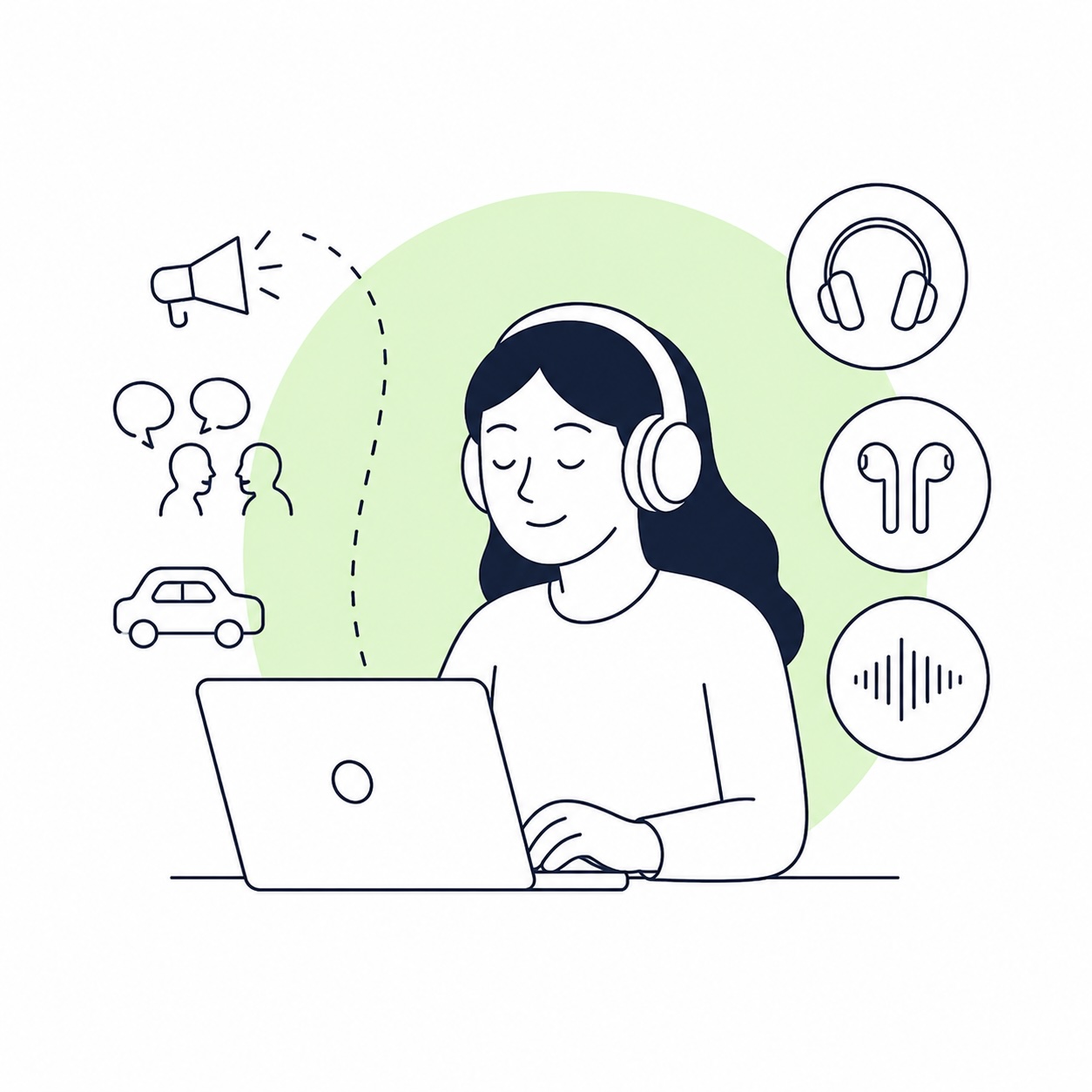
Noise rarely looks like the main problem in your day. More often it works like a background bug that slowly eats away at your ability to start a task, hold context, and avoid tipping into irritation. For people with ADHD, this is especially familiar: someone is talking nearby, the coffee machine is blasting in the cafe, something is buzzing in the apartment, and your brain spends more energy filtering the environment than doing the work itself.
That is why noise-cancelling tech is often more useful than yet another planner. It does not solve executive dysfunction and it does not make anyone more disciplined. What it can do is remove part of the external friction. And sometimes that is exactly the difference between "I am about to start" and forty minutes of preparing to work without actually working.
Important: pricing and availability can change. Check the official store or your local retailer before buying.
Why noise breaks deep work so easily
For many people with ADHD, the problem is not that the environment is objectively loud. The problem is that the brain keeps deciding whether each new sound matters. Nearby voices, fragments of conversation, street noise, home appliances, even the low hum of an air conditioner can pull attention away from work faster than you notice. If that happens again and again throughout an hour, friction builds up and getting started becomes harder.
That is why good noise-cancelling tech does not have to create perfect silence. Its job is simpler: reduce the number of sound triggers your brain has to process in the background. For some people that means large over-ear headphones. For others, simple earplugs are enough. And for some, the best option is combining ANC with neutral background sound like brown noise.
1. Sony WH-1000XM6
Best if you want one strong pair of headphones for home, office, and cafes
- What it is: full-size wireless over-ear headphones with active noise cancellation.
- Who it is for: people who want to cut down office hum, transport noise, or background buzzing at home as much as possible.
- ADHD use case: sit down at your Mac, turn ANC on even without music, and get into work mode faster.
- Mac / iPhone compatibility: works with Mac, iPhone, and iPad over Bluetooth.
- Price: premium tier, roughly around $400.
- Main advantage: does a very good job reducing the kind of background noise that most often breaks deep work.
- Main limitation: large headphones are not comfortable for everyone over long sessions, especially outside the house or in warmer weather.
This is a strong option for people who want the feeling that the room has literally become quieter. Headphones like these do not erase human speech perfectly, but they are excellent at reducing low-frequency background noise: air conditioners, roads, trains, open-plan offices, and general household hum. For many people with ADHD, that is already enough to stop the brain from scanning the room every few seconds.
Another plus is that the over-ear format often works better for long stretches of focused work. If sitting in earbuds for two or three hours feels physically annoying, this kind of setup may be the more realistic everyday solution.
2. AirPods Pro 2
Best for Apple users who want the lowest-friction option throughout the day
- What it is: compact ANC earbuds with tight Apple ecosystem integration.
- Who it is for: people who constantly move between iPhone, Mac, calls, walks, and laptop work.
- ADHD use case: switch noise cancellation on the moment you need it without turning work startup into a separate ritual.
- Mac / iPhone compatibility: excellent integration with Mac, iPhone, and iPad, plus automatic device switching.
- Price: roughly $199 to $249 depending on market and discounts.
- Main advantage: very low daily friction, especially if you already live inside the Apple ecosystem.
- Main limitation: the in-ear fit is not ideal for everyone in long deep-work sessions, and the ANC is still weaker than a great pair of over-ear headphones.
AirPods Pro 2 are not great because they are the absolute noise-cancelling champion. They are great because they are easy to actually use. Take them out of the case, put them in, done. That matters with ADHD: if a tool is annoying or adds extra steps, it often fails exactly when you need it most.
They also fit well into a short startup workflow. Turn on Work Focus on your Mac, put in the AirPods, launch the same background sound or timer, and start. The fewer tiny decisions you make at the beginning, the better your odds of actually getting into the task.
3. Loop Quiet 2
Best if the problem is not just noise, but sensory overload in general
- What it is: reusable passive earplugs with no battery, Bluetooth, or apps.
- Who it is for: people who feel drained by sound pressure itself, even without music, calls, or podcasts.
- ADHD use case: reduce household or city noise without adding one more device that needs charging and maintenance.
- Mac / iPhone compatibility: no direct integration, but that is the point: they work without screens and without setup.
- Price: budget-friendly, around $20 to $25.
- Main advantage: a very simple and inexpensive way to noticeably lower noise load.
- Main limitation: not a fit if you need to listen to calls, music, or audio from your Mac or iPhone at the same time.
This is not a glamorous gadget, but it is an extremely practical one. Sometimes the problem is not that you need better sound. The problem is simply that your environment is too loud. In that situation, basic earplugs can work better than expensive headphones, especially at home where you may not want to spend the whole day wearing tech.
Loop Quiet 2 is especially useful in situations where you want the world turned down, not a full audio experience. Think household noise, commuting, open offices, noisy cafes, nearby neighbors, or construction sounds. It is a small purchase that often creates disproportionate value.
4. Brown noise or white noise through an app or dedicated device
Best if what breaks you most is human speech and fragments of conversation
- What it is: sound masking through white noise, pink noise, brown noise, or calm ambient sounds like rain.
- Who it is for: people who do not benefit much from silence, but do better with a controlled neutral background.
- ADHD use case: mask voices in an open office, cafe, or home environment so your brain hooks onto them less often.
- Mac / iPhone compatibility: can be used through a Mac, iPhone, iPad, or a dedicated white-noise device.
- Price: anything from free apps to around $40 to $60 for a separate device.
- Main advantage: often works better against speech than ANC alone with no background audio.
- Main limitation: you have to find the right sound profile, because some people find white noise more irritating than helpful.
This is the point many headphone roundups miss: not all noise should be removed. Sometimes it should be covered. Human speech is simply too interesting to the brain. Even when you do not want to listen, part of your attention still goes there. That is why brown noise or rain ambience can sometimes work better for deep work than an expensive pair of headphones with nothing playing.
If you already own headphones, this may be the cheapest upgrade to your entire focus setup. Sometimes the right background sound does more than a new gadget.
What I would actually recommend buying
If you want one strong all-purpose option for work, I would start with a good pair of over-ear ANC headphones like the Sony WH-1000XM6. If you live inside the Apple ecosystem and want the lowest possible friction, AirPods Pro 2 are more practical than many more "serious" audio choices. If your budget is tighter or the problem is more about sensory overload than music and calls, Loop Quiet 2 offers a very good usefulness-to-price ratio.
And if what breaks you most is human speech, I would not stop at headphones alone. Try ANC plus brown noise. For a lot of people, that is the real deep-work combo.
Who this may not work for
Noise-cancelling tech does not always help if the bigger problem is internal overload rather than the environment itself. It does not replace sleep, treatment, therapy, medication, or decent day structure. And if wearing something on your head or in your ears feels physically unpleasant, the best technical option on paper may still be the worst one in real life.
That is why I would look at more than raw cancellation strength. Three things matter more: do you actually want to wear it every day, does it reduce friction, and do you genuinely start working faster after you put it on?
What works best
A good noise-cancelling device for ADHD is not the one that wins the most impressive lab test. It is the one after which your day falls apart less. Start with the simplest possible scenario: one noisy environment, one solution, one work block. If it genuinely lowers cognitive load, you will feel it fast.
From there, you can build your own system: headphones for deep work, earplugs for daily noise, and background sound for the moments when silence alone is not enough.